

Hotel Booking MCP Server & AI Tech Stacks

Table of Contents
Hotel bookings are shifting from traditional search forms to conversational, AI-agent-driven interactions. AI assistants are emerging as a new distribution layer, capable of guiding guests through the entire planning process and completing bookings in real time.
Consider a potential guest planning a Las Vegas weekend getaway. Not long ago, that process looked like multiple browser tabs, layered search filters, and hours of cross-referencing hotels, flights, and activities across a half-dozen websites. It was time-consuming by design, and research from Expedia suggests the average traveler spends between 5 and 20 hours planning a trip.
AI is changing that. Tools like ChatGPT, Claude, and Gemini have turned trip planning into a conversation. A traveler can now ask, “What hotels near the Las Vegas Strip have rooms for under $100 a night for two people?” and receive relevant, curated results in seconds. Google is leaning further into this shift, too—the company recently announced that travelers can now track prices for individual hotels directly in Search, adding another layer of AI-assisted decision-making to the booking journey.
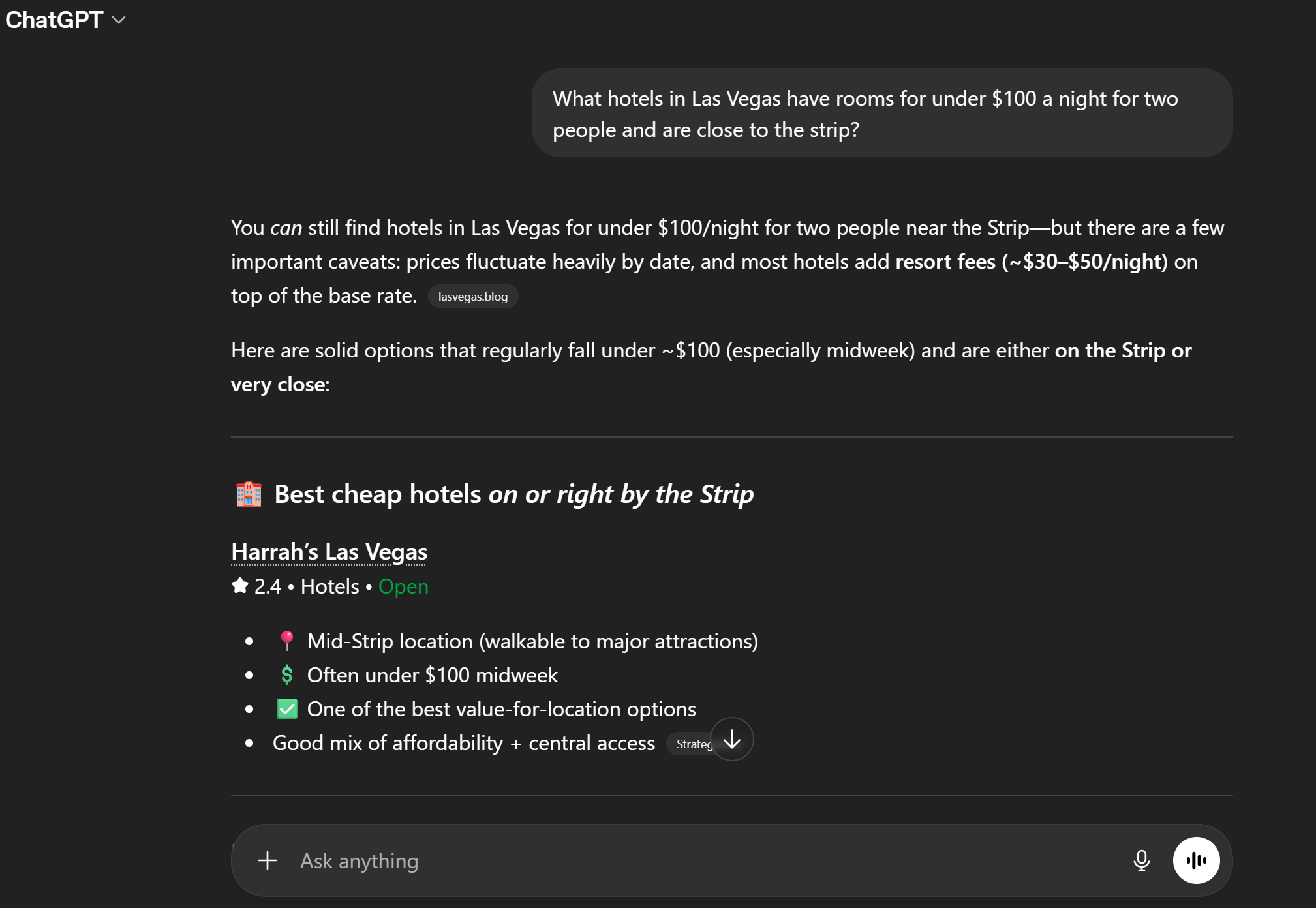 An example using ChatGPT to search for cheap hotels in Las Vegas.
So the question for hoteliers becomes: “How do I show up in AI?”
That’s where the booking MCP server comes in. And what makes it urgent is that AI tools only surface accommodations that have an MCP server in place. Without one, your property simply won’t appear in AI-generated results, no matter how competitive your rates or how strong your reviews.
- Modern travelers increasingly book through AI-powered conversational tools rather than traditional search forms.
- Zucchetti’s Model Context Protocol (MCP) enables generative AI models to access real-time availability, rates, and inventory from the hotel’s booking engine, Simple Booking.
- MCP servers support dynamic, event-driven workflows, context-aware personalization, and real-time updates that traditional APIs cannot match.
- Integrated MCP architecture reduces system lag, prevents fragmented AI tools, and ensures one version of truth across your hotel tech stack.
- Preparing your hotel for MCP integration requires API-first infrastructure, accurate inventory, and a phased implementation roadmap.
What Is a Hotel Booking MCP Server?
 MCP stands for Model Context Protocol, a framework that allows generative AI models to connect directly to live hotel systems and complete real transactions. Not just answer questions or give options, but actually book a room.
Zucchetti’s MCP framework connects AI assistants directly to Simple Booking IBE, the company’s web booking engine, in real time.
Through that connection, an AI agent can instantly:
- Access current room availability across all rate plans
- Retrieve live pricing that reflects dynamic rate adjustments from the RMS
- Confirm a reservation with a write-back directly to the PMS, all within a single conversation.
Think of the MCP server as a translator. On one side, you have a guest talking to an AI assistant. On the other hand, you have your core hotel systems holding all the data that matters (rates, inventory, guest records). The MCP server bridges those two worlds, giving the AI the real-time context it needs to move from conversation to confirmed booking without a human stepping in.
How a Booking MCP Server Differs from Traditional APIs
Traditional APIs rely on static requests where availability, rates, or reservations are handled independently. In contrast, MCP servers enable AI agents to execute dynamic, context-aware workflows:
- Instant inventory confirmation through the CRS before finalizing bookings
- Personalized, context-driven booking experiences based on guest data and preferences
The practical differences between the two approaches are significant, and worth understanding before evaluating your options.
Traditional API vs. Booking MCP Server: A Side-by-Side Comparison
| Feature | Traditional API | Booking MCP Server | Business Impact |
| Inventory | Snapshot-based | Real-time confirmation | Prevents overbooking and errors |
| Personalization | Limited | Context-aware, dynamic | Increases conversion through tailored offers |
| Workflow | Request-response | Agent-driven orchestration | Enables conversational and multi-step interactions |
| AI Integration | Minimal | Full generative AI access | Direct bookings within AI tools |
The Role of MCP in Hotel Tech Stack Integration
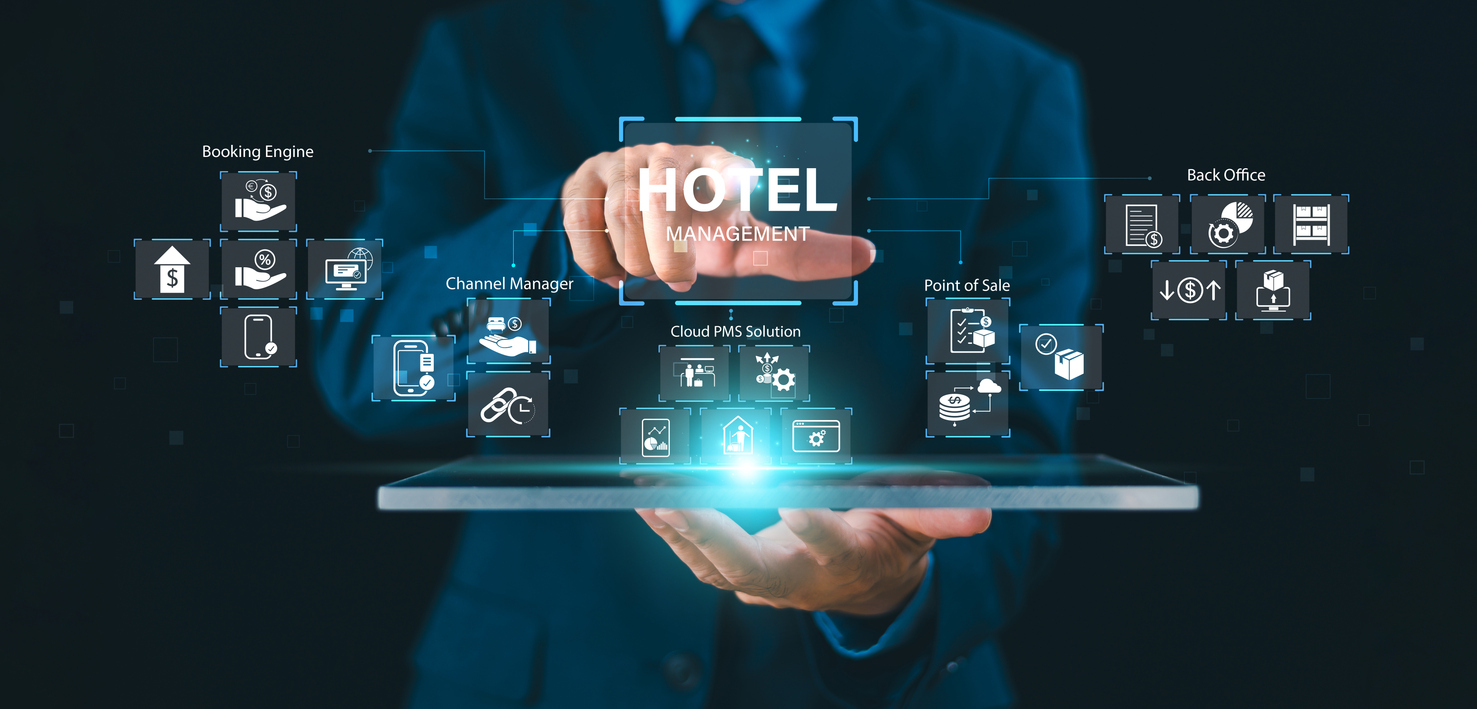 A booking MCP server doesn’t operate in isolation. Its value is directly tied to how deeply it connects with the systems already running your property. When MCP is embedded within your core technology stack, it becomes the connective tissue that allows AI agents to act on real data, in real time, across every layer of your operation.
Connecting MCP Across Your CRS, PMS, and RMS
For an AI agent to handle a booking end-to-end, it needs more than a connection to a single system. It needs to know what’s available (your CRS), what’s happening on property (your PMS), and what the right rate is for that moment in time (your RMS). When your MCP server is embedded across all three, an AI agent can move through each of those touchpoints seamlessly, confirming inventory, retrieving guest history, and applying current pricing, without breaking the conversation or handing off to a human.
This is a meaningful shift from how most hotel technology has historically worked, where each system answered its own questions independently. MCP changes that by enabling a single, coordinated workflow that spans the entire stack.
MCP vs. Traditional Channel Managers
It’s worth clarifying how MCP differs from the channel management tools most hoteliers are already familiar with. Traditional channel managers are built to push rates and availability out to OTAs and other distribution partners. But they weren’t designed to support the kind of dynamic, two-way, conversational interactions that AI agents require.
An MCP server operates differently. Rather than broadcasting static updates to external platforms, it gives AI agents direct, structured access to your systems, allowing them to query, confirm, and transact based on live data. Think of your channel manager as the road your inventory travels on, and your MCP server as the interface that lets AI agents navigate it intelligently.
Avoiding Fragmented AI with an Integrated Booking MCP Server
As AI tools have proliferated, so has the temptation to bolt them onto existing systems one at a time—a chatbot here, an AI rate widget there. It’s an understandable approach, but it creates real problems.
Each standalone AI tool typically pulls from its own data source, operates on its own logic, and has no awareness of what the other tools are doing. The result is a fragmented guest experience, inconsistent data, and decisions being made by AI agents that don’t have the full picture. In a worst-case scenario, a guest is quoted one rate in a chat widget, a different rate in the booking engine, and receives a confirmation that reflects neither.
An integrated MCP architecture solves this by establishing a single source of truth across your stack. When your CRS, PMS, and RMS are all accessible through one MCP layer, every AI interaction draws from the same data. Rates are consistent. Inventory is accurate. Guest context carries through from the first message to the final confirmation.
This is the difference between AI that adds complexity to your operation and AI that actually simplifies it.
Where MCP Sits in the Hotel Technology Stack
| Layer | Function | Examples | AI Interaction Enabled |
| Central Reservation System (CRS) | Manages rates, inventory, and distribution across channels | Vertical Booking | Real-time availability queries and booking confirmation |
| Property Management System (PMS) | Handles on-property operations, guest profiles, and folios | Lodgical Solution | Guest history retrieval and stay personalization |
| Revenue Management System (RMS) | Drives pricing strategy through demand forecasting and market data | Lybra Assistant | Dynamic rate access at the point of booking |
| Internet Booking Engine (IBE) | Converts direct traffic into confirmed reservations | Simple Booking | AI-assisted direct booking without OTA involvement |
| Point of Sale (POS) | Manages food, beverage, retail, and ancillary revenue | TCPOS | Upsell and ancillary offers integrated into the guest journey |
Preparing Your Hotel Tech Stack for MCP Server Integration
 Getting your property ready for MCP integration comes down to three things: confirming your core systems support open API connectivity, ensuring your data is clean and consistently structured, and working with technology vendors who are actively building for MCP. From there, integration can follow a straightforward phased roadmap that minimizes disruption and validates performance at every step.
Do You Have an API-First Infrastructure?
MCP servers communicate through APIs, so the starting point is understanding whether your current systems are built to support that connectivity. An API-first infrastructure means your PMS, CRS, and RMS are designed to expose their data through standardized interfaces that other systems can access programmatically.
This is increasingly the norm in modern hospitality technology, but it’s not universal. Legacy systems were often built as closed environments with limited external access. Before evaluating an MCP server, ask your technology vendors a straightforward question, ensure all of your systems can effectively communicate with each other and that they support open API access.
Evaluating MCP Readiness
A useful way to assess your readiness is to look across four key areas:
- Connectivity: Can your CRS, PMS, and RMS expose live data through a well-documented, actively maintained API?
- Data quality: MCP servers surface what’s already in your systems. Inconsistent rate plans, incomplete guest profiles, or inaccurate inventory will show up in AI-generated results. Clean, structured data is a prerequisite, not an afterthought.
- Security: AI agents accessing your systems through MCP need to do so securely. Confirm that your infrastructure supports token-based authentication and that access is properly permissioned and audited.
- Vendor alignment: MCP integration works best when your technology partners are actively building for it, so ensure that it’s at least a planned near-future update.
Conclusion
Travelers now expect AI-driven, conversational booking experiences. Zucchetti’s Model Context Protocol (MCP) transforms the distribution layer by providing generative AI models with real-time access to the hotel’s Simple Booking engine. This enables direct bookings, dynamic pricing, and personalized offers within AI tools while maintaining one version of truth across CRS, PMS, and RMS.
Hotels implementing MCP servers gain control over AI-driven distribution, avoid fragmented systems, and create a foundation for future innovation in guest engagement and revenue management.
Contact Zucchetti America today to explore how a hotel booking MCP server can integrate your systems, unlock AI-driven revenue strategies, and position your property for the future of travel distribution.








North America
Zucchetti North America offers hospitality solutions to hotels and other lodging providers, as well as on-site dining operations across North America.
Quick Links
Contact Us

34 West Oak St, Sturgeon Bay, WI 54235
7901 Kingspointe Pkwy Ste 9, Orlando, FL 32819
500 SW 116th Ave, Portland, OR 97225

+1.503.343.4263

sales@zucchettinorthamerica.com
©2026 Zucchetti. All rights reserved.