

10 Best Revenue Management Software Options to Boost Hotel Profitability

Table of Contents

Hotel revenue management has come a long way from manually adjusting room rates based on occupancy. Today’s platforms use AI, real-time market data, competitor pricing, and demand forecasting to help hotels earn more while spending less time on manual pricing decisions.
For independent hotels, boutique properties, and multi-property operators, the right revenue management system (RMS) can move the needle on revenue per available room (RevPAR), average daily rate (ADR), occupancy, and overall profitability. The challenge is that there are more options than ever, each with different strengths, pricing models, and levels of automation.
Some platforms are built for global hotel brands that need deep enterprise analytics. Others give smaller operators enterprise-level automation without requiring a dedicated revenue manager on staff. Knowing the difference matters before you commit to a platform.
This guide compares 10 of the best hotel revenue management software solutions available today, covering who each one is built for, where it performs best, and what to look for when evaluating your options.
- The best revenue management software for hotels combines AI-powered pricing, demand forecasting, competitor intelligence, and seamless PMS and CRS integrations to maximize hotel profitability.
- Independent hotels often benefit most from platforms that automate pricing decisions while remaining easy to configure and manage without a full-time revenue team.
- Integration matters just as much as pricing intelligence. An RMS that works natively with your PMS, CRS, and booking engine reduces operational complexity and improves pricing accuracy.
Summary Comparison of the Best Revenue Management Software for Hotels
| Software | Best for | Standout feature |
| Lybra Assistant RMS | Independent hotels, boutique properties, hotel groups | Flight search data for earlier demand forecasting |
| IDeaS G3 RMS | Enterprise hotels and branded chains | Advanced machine learning optimization |
| Duetto | Lifestyle hotels and upscale independents | Open pricing methodology |
| Atomize | Independent hotels seeking automation | Fully automated pricing engine |
| RoomPriceGenie | Small hotels and B&Bs | Beginner-friendly automation |
| Cloudbeds PIE | Existing Cloudbeds users | Native Cloudbeds integration |
| SiteMinder Dynamic Revenue Plus | Hotels using SiteMinder distribution tools | Distribution and pricing in one platform |
| Cendyn | Hotels combining CRM and revenue management | Revenue and marketing alignment |
| BEONx | Hotels focused on profitability optimization | Total revenue management insights |
| Lighthouse | Hotels prioritizing competitor intelligence | Industry-leading rate shopping data |
10 Best Revenue Management Software Options for Hotels

The best revenue management software helps hotels move beyond reactive pricing by using AI, demand forecasting, and market intelligence to optimize rates in real time. Below are 10 leading RMS platforms, each offering a unique mix of automation, analytics, and integrations to suit different hotel types and operational needs.
1. Lybra Assistant RMS by Zucchetti North America
Ideal for
- Independent hotels and boutique properties
- Multi-property groups and management companies
- Properties without a dedicated revenue manager
Why it stands out
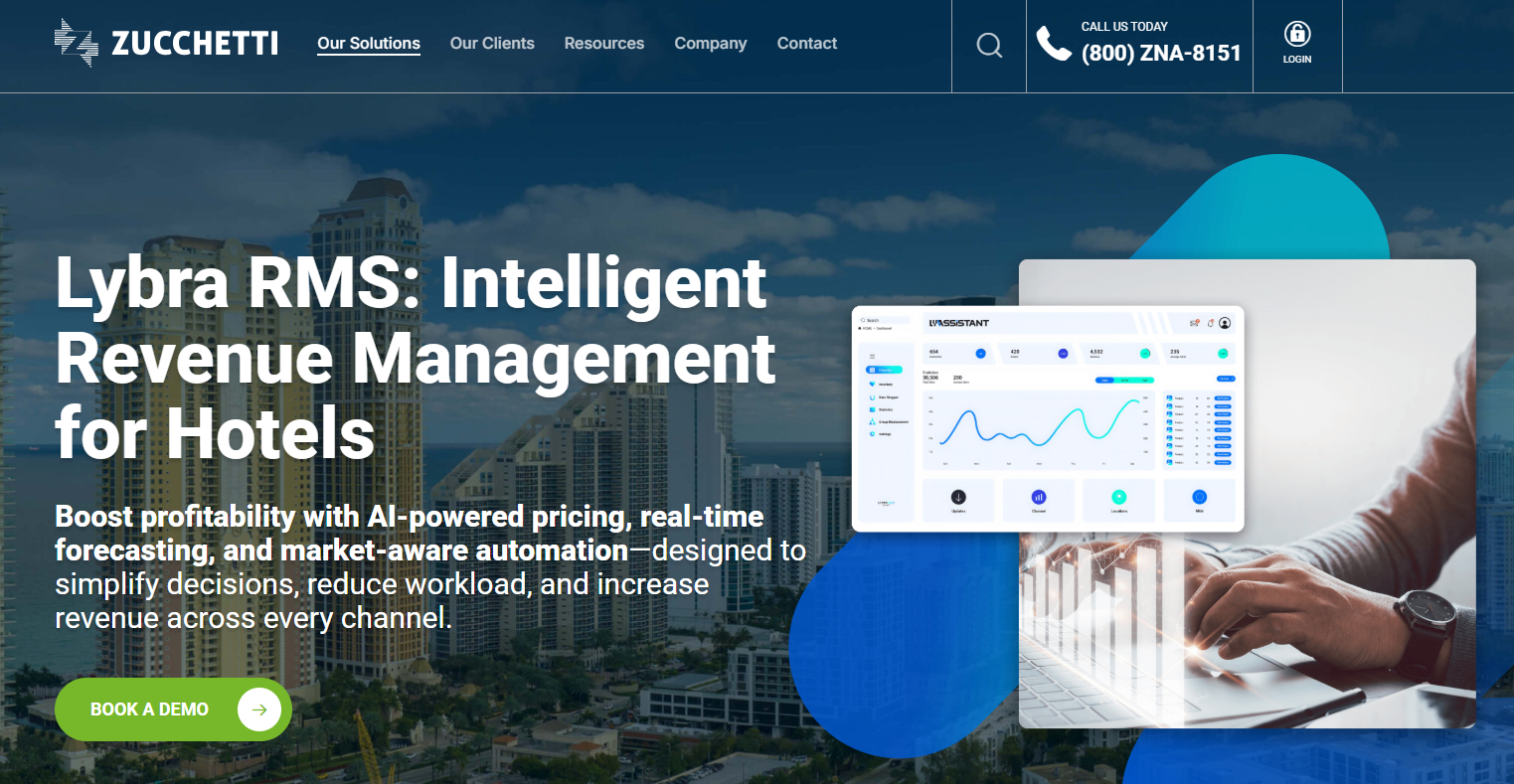
Lybra Assistant delivers sophisticated revenue optimization without requiring hotels to build a dedicated revenue management department. The AI-powered platform continuously evaluates market conditions, competitor pricing, and booking trends to automate many of the pricing decisions that would otherwise consume hours of manual work every week.
Its biggest differentiator is the use of flight search data as an early demand indicator. Rather than relying solely on historical booking pace, Lybra analyzes airline search behavior to identify travel demand before reservations are made. This gives hotels additional time to adjust pricing strategies ahead of market shifts.
For destinations heavily influenced by air travel, this forward-looking intelligence can provide a meaningful competitive advantage compared to platforms that primarily react to booking activity after demand has already begun increasing.
Another advantage is its position within the broader Zucchetti North America hospitality ecosystem. Hotels using Lodgical Solution PMS, Vertical Booking CRS, Simple Booking IBE, and TCPOS benefit from native connectivity across core operational systems instead of depending on multiple third-party integrations.
Key capabilities
- AI-powered autopilot pricing
- Real-time rate automation
- Competitor rate monitoring across OTAs
- Demand forecasting using flight search data
- Group displacement analysis
- Bi-directional PMS and CRS integration
- Native integration with the Zucchetti North America hospitality platform
For independent hotels looking to increase revenue while simplifying day-to-day pricing decisions, Lybra Assistant combines automation, predictive analytics, and seamless system connectivity in a platform designed specifically for modern hospitality operations.
2. IDeaS G3 RMS
Ideal for
- Full-service hotels
- Branded chains
- Large multi-property portfolios
Why it stands out
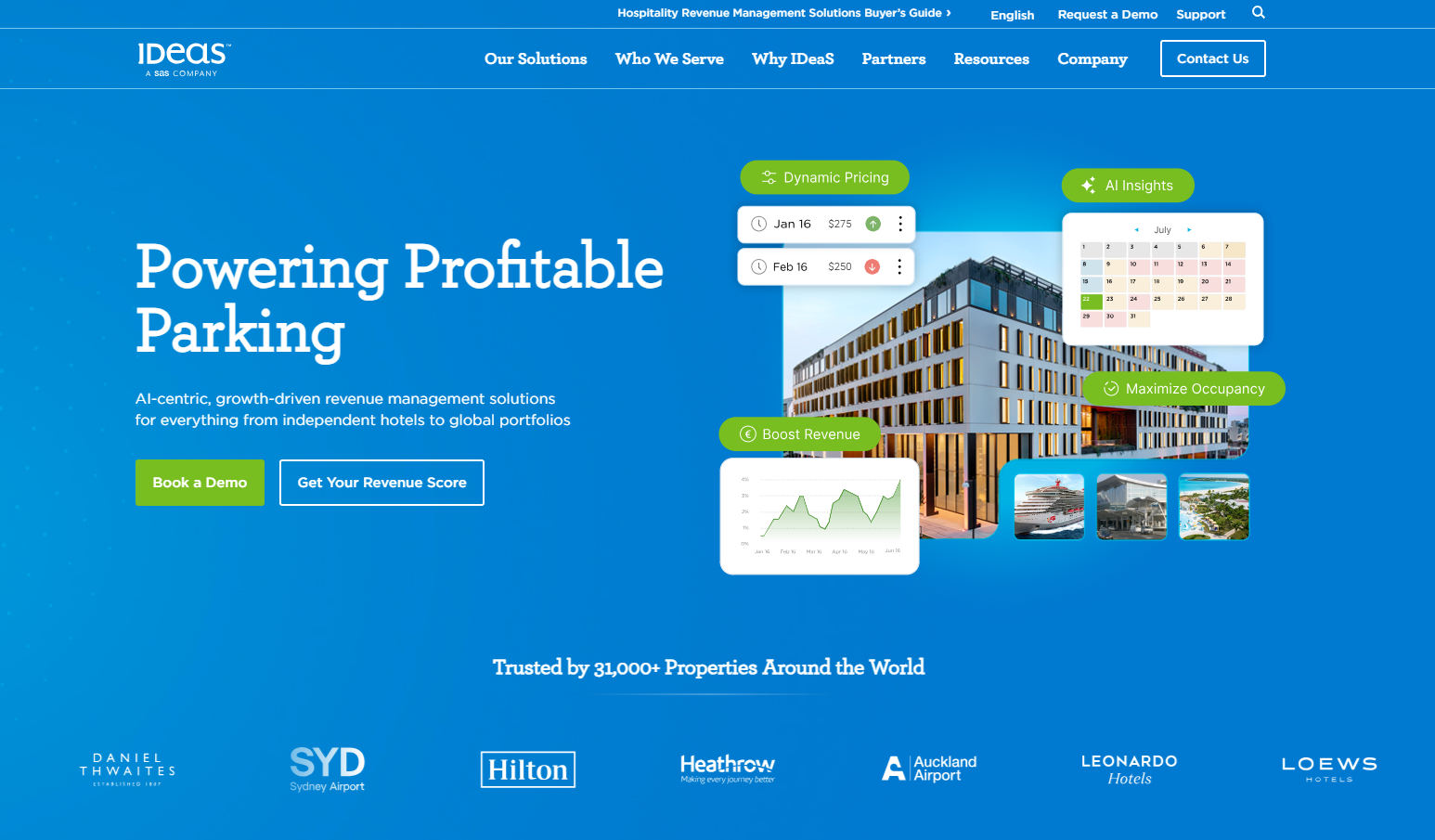
IDeaS has long been regarded as one of the industry’s most established revenue management providers. Its G3 Revenue Management System is built to support hotels with large inventories, multiple room categories, complex distribution strategies, and sophisticated pricing requirements.
The platform applies machine learning models across thousands of pricing decisions, helping revenue teams optimize rates by room type, booking channel, arrival date, and length of stay. Rather than replacing experienced revenue managers, G3 gives them deeper analytical insight while automating repetitive pricing tasks.
One of its greatest strengths is configurability. Enterprise operators can establish detailed pricing rules, approval workflows, and reporting structures that support corporate governance while maintaining flexibility at the property level.
Key capabilities
- Machine learning-based pricing optimization
- Automated pricing recommendations
- Portfolio management across multiple hotels
- Group displacement analysis
- Meeting and event revenue optimization
- Enterprise reporting and forecasting
- Broad PMS integrations
Hotels operating at enterprise scale often require detailed audit trails and advanced reporting capabilities. IDeaS G3 is particularly well-suited for organizations with dedicated revenue professionals who want extensive control over pricing strategy.
3. Duetto
 Ideal for
 Ideal for
- Upscale independent hotels
- Lifestyle brands
- Soft-brand properties
Why it stands out
Duetto helped popularize the concept of open pricing, allowing hotels to independently adjust rates by room type, booking channel, and date instead of applying uniform pricing rules across all inventory.
This flexibility enables revenue teams to develop more targeted pricing strategies based on customer segments, distribution costs, and booking behavior. Hotels can respond quickly to changing market conditions while maintaining greater control over profitability across different channels.
Duetto also emphasizes real-time data analysis, allowing pricing recommendations to adapt continuously as market conditions evolve throughout the booking window.
Its reporting capabilities provide visibility into booking pace, competitor positioning, and demand trends, helping revenue managers make informed pricing decisions while reducing manual analysis.
Key capabilities
- Open pricing by room type and channel
- Dynamic pricing recommendations
- Group and event pricing tools
- ScoreBoard analytics and reporting
- Demand forecasting
- Booking pace analysis
- Multi-property reporting
Duetto is particularly attractive for hotels with experienced revenue teams looking to refine channel-level pricing strategies beyond standard automated rate recommendations.
4. Atomize
Ideal for
- Boutique hotels
- Independent properties
- Hotels seeking fast implementation and high automation
Why it stands out
Atomize has built its reputation around one core principle: revenue management should require as little manual intervention as possible. Instead of asking hotel staff to review every pricing recommendation, the platform can automatically adjust room rates based on changing market conditions, competitor pricing, occupancy levels, and demand signals.
This approach is particularly valuable for independent hotels that don’t employ a dedicated revenue manager. Rather than spending hours reviewing reports and manually updating rates, operators can rely on the platform to make data-driven pricing decisions throughout the day.
Despite its high level of automation, Atomize maintains transparency by allowing users to review pricing logic and monitor performance through intuitive dashboards. Hotels can still establish pricing boundaries and business rules while allowing the software to handle day-to-day optimization.
Another advantage is its relatively quick onboarding process. Compared with enterprise revenue management systems that can require lengthy implementations, Atomize is designed to deliver value quickly with a straightforward setup process.
Key capabilities
- Fully automated dynamic pricing
- Real-time market data analysis
- Continuous rate optimization
- Demand forecasting
- PMS synchronization
- OTA connectivity
- Performance dashboards
- Fast implementation with minimal configuration
For independent hotels looking to move beyond spreadsheets without adding operational complexity, Atomize offers one of the most automated solutions currently available.
5. RoomPriceGenie
Ideal for
- Small independent hotels
- Bed and breakfasts
- Guesthouses
- First-time RMS users
Why it stands out
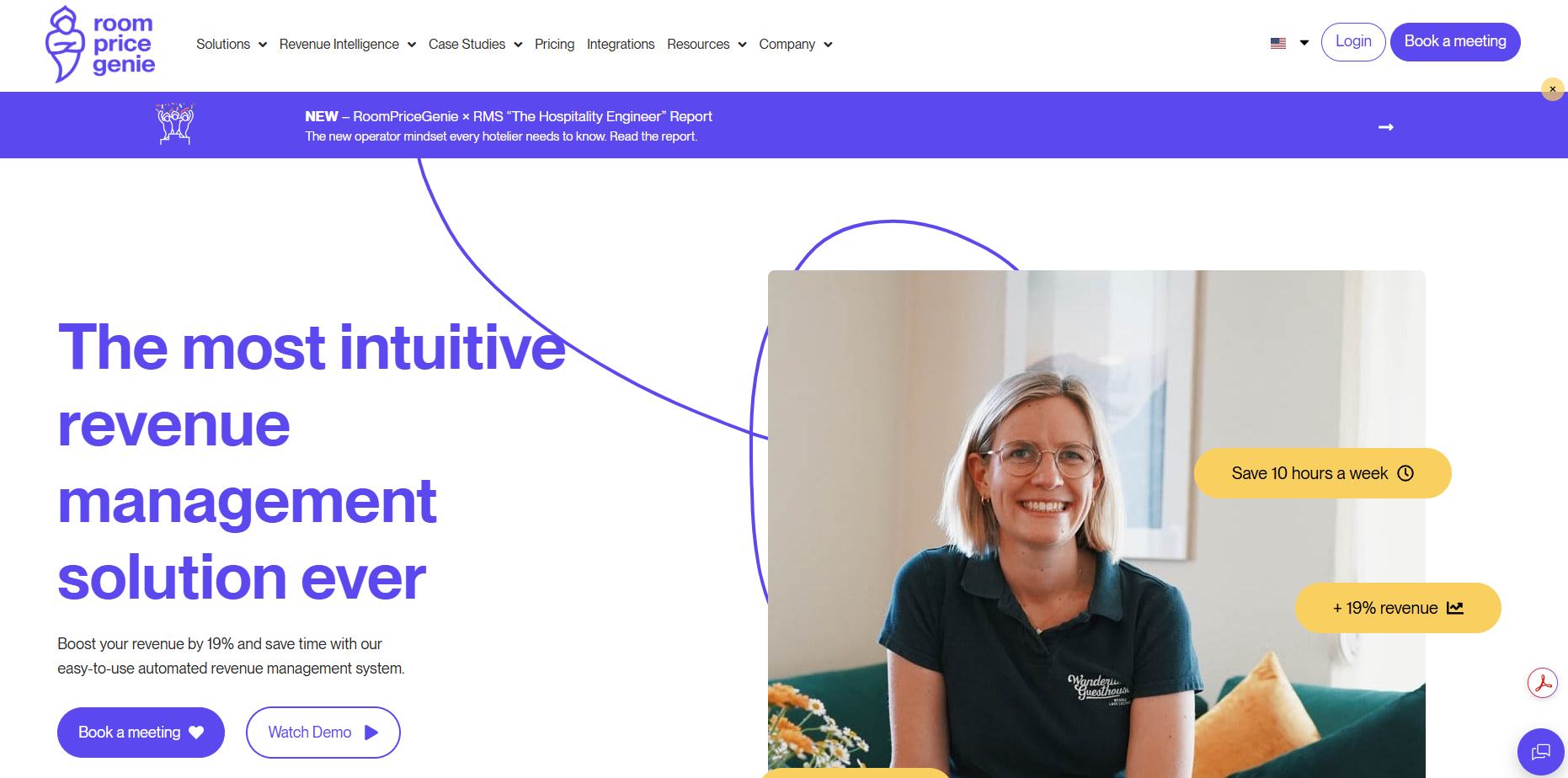
Many smaller accommodation providers hesitate to invest in the best revenue lifecycle management software because enterprise platforms often feel overly complex. RoomPriceGenie addresses this challenge by focusing on simplicity without sacrificing meaningful automation.
The platform was designed for operators who may not have formal revenue management experience. Instead of requiring users to interpret extensive pricing reports or configure dozens of pricing rules, RoomPriceGenie handles much of the analytical work behind the scenes while presenting recommendations in a straightforward interface.
Its pricing suggestions remain transparent, allowing hotel operators to understand why rates are changing and override recommendations whenever necessary. This balance between automation and visibility makes it an approachable option for businesses transitioning away from manual pricing.
The software also integrates with many popular PMS solutions and online travel agencies, allowing smaller properties to automate pricing without disrupting existing workflows.
Key capabilities
- Automated pricing recommendations
- Competitor rate monitoring
- Demand-based pricing adjustments
- PMS integrations
- OTA connectivity
- Easy-to-use dashboard
- Manual pricing overrides
- Transparent recommendation logic
For hotels beginning their revenue management journey, RoomPriceGenie offers an accessible introduction to AI-assisted pricing while keeping day-to-day operations simple.
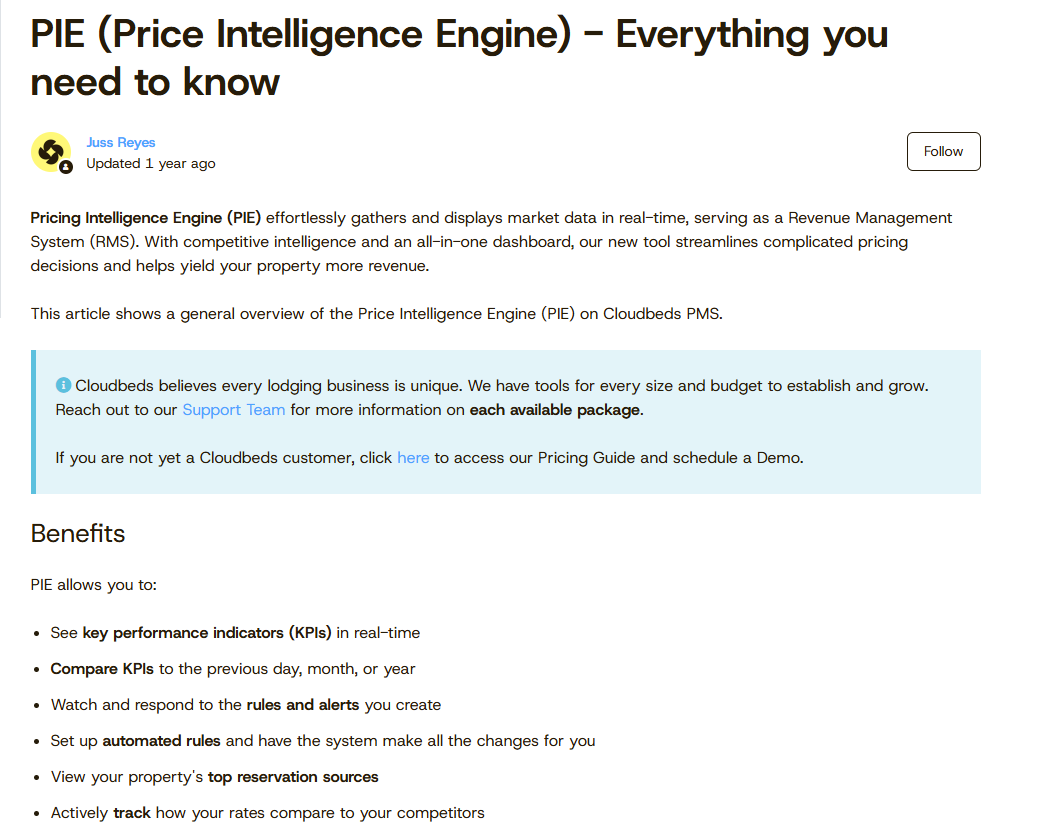
6. Cloudbeds PIE (Pricing Intelligence Engine)
Ideal for
- Small to mid-sized independent hotels
- Boutique properties
- Existing Cloudbeds PMS users
Why it stands out
Cloudbeds PIE is the revenue management component of the broader Cloudbeds hospitality platform. Rather than functioning as a standalone application, it integrates directly into the Cloudbeds ecosystem, allowing operators to manage pricing alongside reservations, distribution, and property operations.
This native integration eliminates many of the implementation challenges associated with third-party revenue management systems. Hotels already using Cloudbeds PMS can activate pricing intelligence without managing multiple vendors or maintaining complex system integrations.
The platform combines occupancy trends, booking pace, and market demand data to recommend pricing adjustments that help maximize both occupancy and average daily rate. Because recommendations are delivered within the same interface staff already use, adoption tends to be straightforward.
For hotels seeking operational simplicity, this all-in-one approach can significantly reduce administrative overhead.
Key capabilities
- Real-time pricing recommendations
- Demand forecasting
- Native Cloudbeds PMS integration
- Channel manager synchronization
- Occupancy and ADR reporting
- Revenue performance dashboards
- Streamlined implementation
Cloudbeds PIE is best suited for operators who have already invested in the Cloudbeds ecosystem and want integrated revenue management without introducing another software platform.
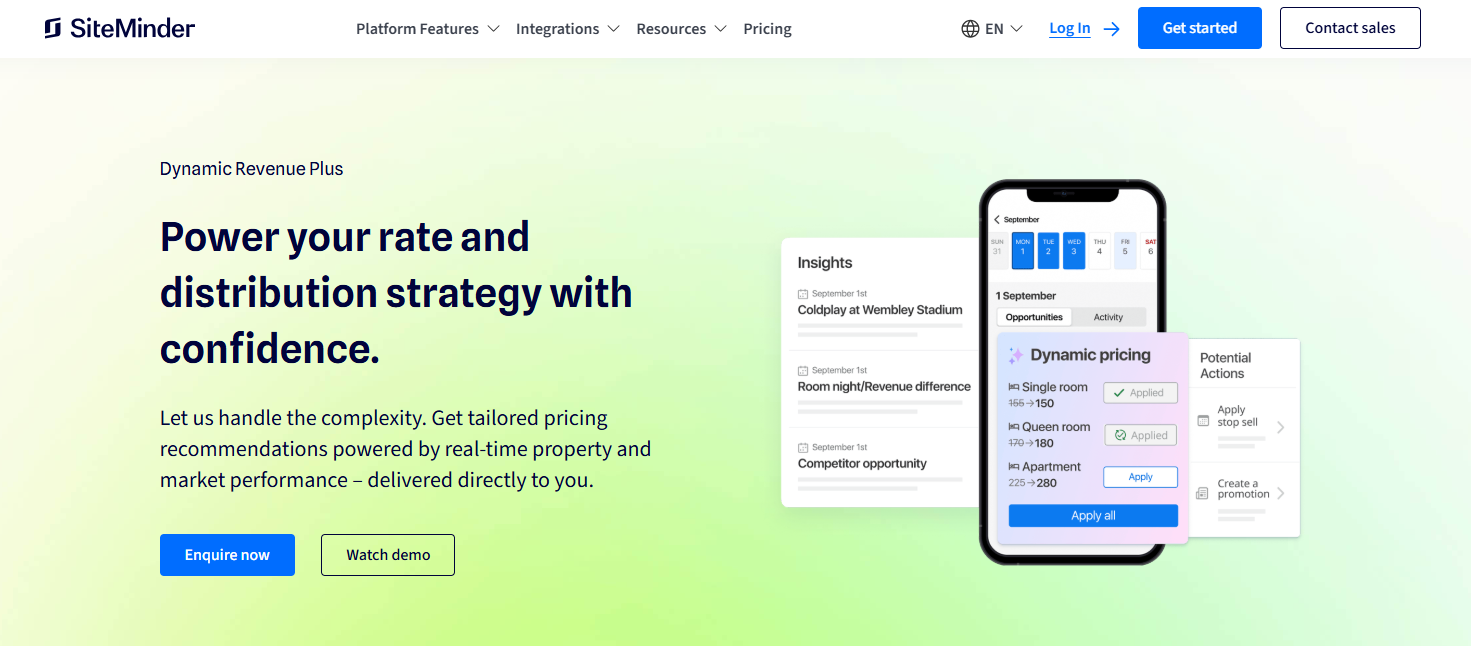
7. SiteMinder Dynamic Revenue Plus
Ideal for
- Independent hotels
- Small and mid-sized hotel groups
- Hotels already using SiteMinder’s distribution platform
Why it stands out
SiteMinder Dynamic Revenue Plus combines revenue management with one of the hospitality industry’s most widely used distribution ecosystems. Hotels already relying on SiteMinder for channel management can extend their technology stack with AI-driven pricing recommendations while maintaining a familiar operating environment.
The platform analyzes market demand, competitor pricing, occupancy trends, and booking behavior to recommend optimal room rates throughout the booking window. Because pricing and distribution operate within the same ecosystem, hotels can respond more quickly to market changes while reducing manual updates across multiple channels.
Dynamic Revenue Plus is designed to help smaller revenue teams make smarter pricing decisions without introducing unnecessary complexity. Hotels retain control over pricing strategies while benefiting from automated recommendations based on continuously updated market data.
For operators looking to simplify both distribution and pricing management, SiteMinder offers a practical balance between automation and ease of use.
Key capabilities
- AI-powered pricing recommendations
- Real-time market demand analysis
- Competitor rate monitoring
- Native integration with SiteMinder Channel Manager
- Occupancy and booking pace analysis
- Automated pricing suggestions
- Performance reporting dashboards
Hotels already using SiteMinder’s distribution platform can gain additional value by adding Dynamic Revenue Plus, reducing the need for separate pricing tools while improving revenue optimization across all booking channels.
8. Cendyn
Ideal for
- Full-service hotels
- Resorts
- Hotels focused on combining revenue management with guest marketing
- Properties with active loyalty programs
Why it stands out
Cendyn takes a broader approach to revenue optimization by connecting pricing decisions with guest relationship management. Rather than treating revenue management and marketing as separate functions, the platform combines CRM data, guest profiles, marketing automation, and revenue intelligence to help hotels maximize lifetime guest value.
This integrated approach enables hotels to make pricing decisions based not only on market demand but also on guest segments, loyalty activity, and direct booking opportunities. Marketing teams and revenue managers can work from the same data, improving collaboration and reducing silos between departments.
For hotels investing heavily in direct bookings, personalized marketing, and guest retention, Cendyn offers capabilities that extend beyond traditional room pricing.
Key capabilities
- Revenue management integrated with CRM
- Guest profile and loyalty insights
- Marketing automation tools
- Demand forecasting
- Dynamic pricing recommendations
- Revenue and marketing performance reporting
- PMS and CRS integrations
Hotels seeking to align pricing strategy with guest engagement and direct booking initiatives will find Cendyn particularly valuable.
9. BEONx
Ideal for
- Independent hotels
- Small hotel groups
- Properties focused on long-term profitability rather than occupancy alone
Why it stands out
Many revenue management systems concentrate primarily on selling rooms at the highest possible rate. BEONx expands that perspective by emphasizing total profitability across the property.
Its platform combines AI-driven pricing with profitability analysis, helping hotels understand which guest segments, booking channels, and revenue streams generate the strongest financial returns. Rather than focusing exclusively on occupancy or ADR, BEONx encourages operators to evaluate the complete economic value of each booking.
Another distinguishing feature is its inclusion of sustainability metrics alongside financial performance. As environmental reporting becomes increasingly important across hospitality, hotels can begin evaluating operational decisions through both profitability and sustainability lenses.
This broader approach makes BEONx particularly appealing for operators looking to optimize long-term business performance instead of simply maximizing room revenue.
Key capabilities
- AI-powered pricing optimization
- Demand forecasting
- Total revenue management
- Profitability analysis by segment
- Sustainability performance tracking
- Custom reporting dashboards
- Revenue insights across rooms and ancillary services
For hotels that measure success by overall profitability rather than occupancy alone, BEONx provides a more comprehensive decision-making framework.
10. Lighthouse (formerly OTA Insight)
Ideal for
- Independent hotels
- Revenue teams focused on competitive pricing
- Hotels seeking stronger market intelligence
Why it stands out
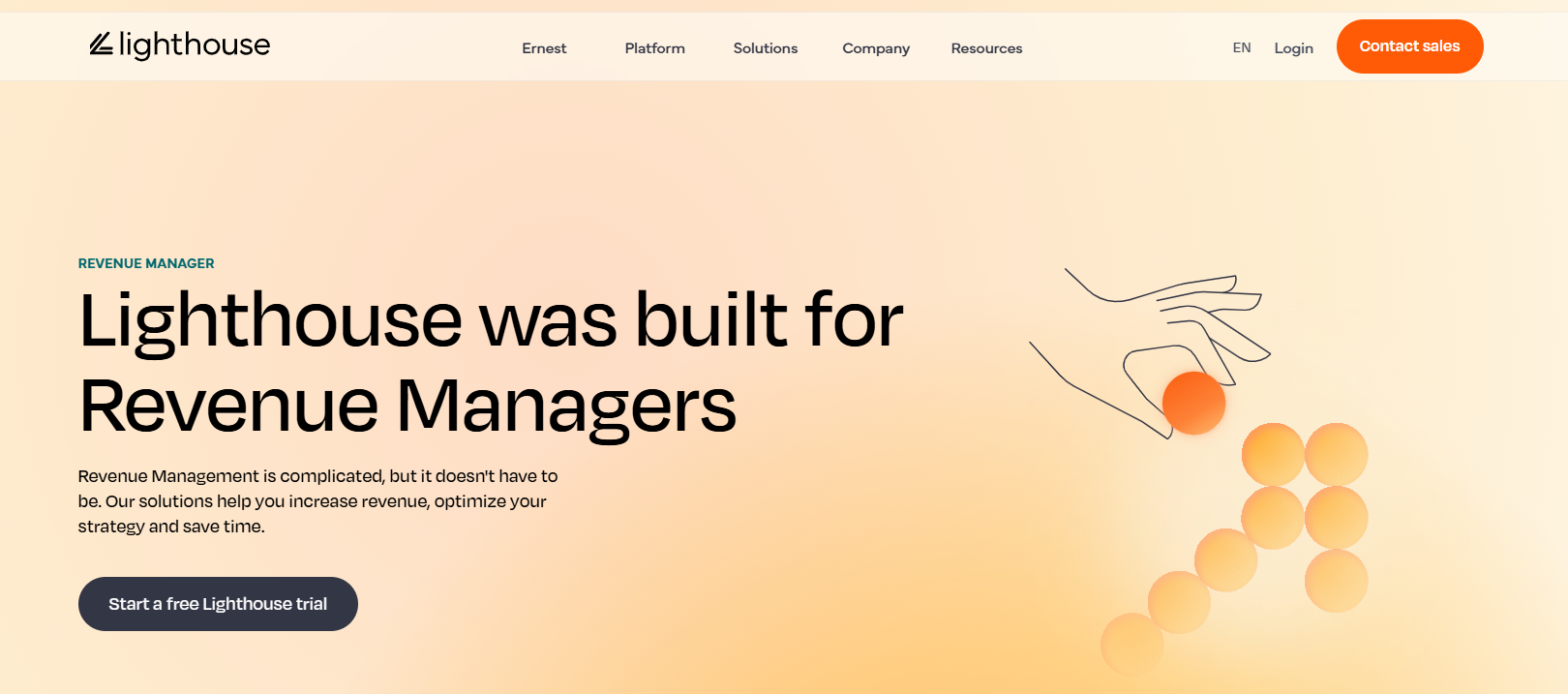
Lighthouse built its reputation through industry-leading rate shopping and competitive intelligence before expanding into a broader revenue management platform. Today, it remains one of the strongest solutions for hotels that base pricing decisions on market positioning.
The platform continuously monitors competitor pricing across online travel agencies and direct booking channels, allowing hotels to identify pricing opportunities and respond quickly to changing market conditions.
Beyond competitor rates, Lighthouse incorporates forward-looking demand indicators, market trends, and parity monitoring to help hotels maintain competitive pricing without sacrificing profitability.
Its reporting tools provide clear visibility into how a property’s pricing compares with its competitive set, making it easier to adjust strategy as demand fluctuates.
Key capabilities
- Real-time competitor rate monitoring
- Market demand intelligence
- Forward-looking pricing signals
- Rate parity monitoring
- Revenue optimization recommendations
- Competitive benchmarking
- Reporting dashboards
For hotels looking to replace manual rate shopping with automated market intelligence, Lighthouse remains one of the strongest options available.
How to Use Revenue Management Software Effectively
Choosing the right platform is only the first step. The hotels that achieve the strongest results use the best revenue lifecycle management software as an active operational tool rather than a system they configure once and rarely revisit.
| Best practice | Why it matters | Action to take |
| Start with clean, reliable data | Your RMS can only generate accurate pricing recommendations if the underlying PMS data is complete and up to date. | Audit your PMS before implementation, ensuring reservations, room types, rate codes, and market segments are accurate. |
| Define success before implementation | Establishing baseline KPIs makes it easier to measure the impact and ROI of your revenue management software. | Track metrics such as RevPAR, ADR, occupancy, booking pace, direct booking share, and gross operating revenue before go-live. |
| Review pricing strategies regularly | Market conditions, competitor activity, and traveler demand change throughout the year. | Review pricing rules, automation settings, and forecasting assumptions at least once every quarter. |
| Use reporting consistently | Regular performance reviews help identify trends and opportunities before they affect revenue. | Monitor dashboards weekly or monthly to evaluate booking pace, demand forecasts, competitor rates, and pricing performance. |
| Prioritize system integration | Connected systems reduce manual work, improve pricing accuracy, and keep inventory synchronized across channels. | Ensure your RMS, PMS, CRS, booking engine, and channel manager support bi-directional integration. |
Start With Clean, Reliable Data
Revenue management software depends on accurate information. Incomplete reservations, outdated room inventory, inconsistent rate codes, or poor PMS data can all reduce the accuracy of pricing recommendations.
Before implementation, review your property management system to ensure historical booking data, room categories, and market segments are properly maintained.
Define Success Before Implementation
Establish baseline performance metrics before going live with your new RMS. This allows you to measure whether the platform is delivering meaningful improvements over time.
Common KPIs include:
- Revenue per available room (RevPAR)
- Average daily rate (ADR)
- Occupancy
- Booking pace
- Direct booking share
- Gross operating revenue
Tracking these metrics consistently makes it easier to quantify return on investment.
Review Pricing Strategies Regularly
Market conditions evolve throughout the year. Seasonal demand, local events, economic conditions, and competitor activity all influence pricing opportunities.
Review your pricing rules, automation settings, and forecasting assumptions at least once each quarter to ensure they still reflect current market conditions.
Use Reporting Throughout the Year
Revenue dashboards should inform daily and weekly decision-making, not just annual budgeting exercises.
Regularly reviewing forecasting accuracy, competitor positioning, booking pace, and channel performance allows hotels to identify trends before they materially affect revenue.
Prioritize System Integration
Even the most advanced RMS delivers limited value if it operates in isolation.
Bi-directional integration between your revenue management system, PMS, CRS, booking engine, and channel manager ensures rates, availability, reservations, and inventory remain synchronized across every distribution channel. This reduces manual work while improving pricing accuracy and operational efficiency.
Hotels with connected technology stacks are generally better positioned to respond quickly to changing demand while minimizing pricing inconsistencies across channels.
Conclusion

The best revenue management software for hotels is an essential tool for establishments looking to compete in an increasingly dynamic marketplace. AI-powered forecasting, automated pricing, and real-time market intelligence enable properties of all sizes to make faster, more informed pricing decisions while reducing the manual effort traditionally associated with revenue management.
The best platform depends on your property’s size, operational complexity, and existing technology stack. Enterprise hotels may prioritize advanced analytics and portfolio management, while independent properties often benefit most from automation, ease of use, and seamless integration with their core hospitality systems.
For hotels seeking an integrated approach, Lybra Assistant stands out by combining AI-driven pricing with forward-looking flight search data and native connectivity across the Zucchetti North America ecosystem. When paired with Lodgical Solution PMS, Vertical Booking CRS, Simple Booking IBE, and TCPOS, it provides a connected technology stack that helps reduce operational friction while supporting smarter revenue decisions.
Whether you’re implementing your first RMS or replacing an existing platform, choosing software that aligns with your operational goals and integrates cleanly with the rest of your hotel technology will position your property for stronger revenue performance over the long term.
Ready to modernize your hotel’s revenue strategy? Explore the Zucchetti North America hospitality ecosystem, including:
Have questions about where to start? Contact our team, and we’ll help you find the right fit.






Related Articles

Hotel Revenue Management Explained: Basics & Strategies
A single mispriced room can ripple through your entire month’s revenue. Picture watching your competitor...

How to Improve Hotel Sales: 7 Proven Strategies
A hotel can be fully booked on a Saturday night and still be underperforming on...

Customer Revenue Optimization Software: A Hotel Guide
Should you raise your rates this week, or hold steady? Every hotel operator struggles with...

North America
Zucchetti North America offers hospitality solutions to hotels and other lodging providers, as well as on-site dining operations across North America.
Quick Links
Contact Us

34 West Oak St, Sturgeon Bay, WI 54235
7901 Kingspointe Pkwy Ste 9, Orlando, FL 32819
500 SW 116th Ave, Portland, OR 97225

+1.503.343.4263

sales@zucchettinorthamerica.com
©2026 Zucchetti. All rights reserved.