

6 Hotel Automation Examples That Actually Work

Table of Contents

Hotel automation is the use of technology to handle repetitive, data-driven, or time-sensitive tasks that would otherwise require manual staff intervention. What was once considered a luxury reserved for large chains has quickly become an operational necessity. For independent hotels competing against brands with dedicated revenue, distribution, and IT teams, automation is now one of the most practical ways to stay competitive and efficient.
- Start with revenue management for the fastest ROI. Among all hotel automation use cases, automated pricing typically delivers the quickest return by adjusting rates using real-time demand, competitor pricing, and historical data. Most hotels can implement these hotel automation solutions in a few weeks and expand from there.
- Automate distribution to eliminate manual updates. Connecting your PMS and CRS keeps rates and inventory synchronized across OTAs, GDS, and direct booking channels, reducing overbookings, pricing errors, and staff time spent managing multiple extranets.
- Reduce OTA dependency over time. Automated rate matching, personalized booking experiences, and abandoned booking recovery help increase direct bookings and lower commission costs. While results build gradually, every direct reservation improves long-term profitability.
- Prioritize guest-facing and operational workflows. Mobile check-in, digital keys, and integrated POS-PMS systems streamline arrivals, speed up food and beverage service, reduce billing errors, and free staff to focus on delivering a better guest experience.
Hotel Automation Examples Summary
| Automation Area | Problem Solved | How It Works | Key Benefit |
| Automated Rate Management | Manual, spreadsheet-driven pricing decisions | Adjusts rates in real time using occupancy, competitor data, booking pace, and flight search trends | Higher RevPAR, faster decisions, less revenue leakage |
| Channel Distribution | Inventory mismatches and manual OTA updates | Syncs rates and availability across OTAs, GDS, metasearch, and direct channels from a central system | Fewer overbookings, better rate accuracy, less admin |
| Direct Booking Optimization | High OTA commissions (15-30%) and low direct conversion | Automates rate parity, personalized booking experiences, and abandoned booking recovery | More direct revenue, lower commission costs, better guest data |
| Self-Service Check-In | Front desk congestion and slow manual check-in | Enables mobile check-in, kiosks, ID verification, and digital key delivery | Faster arrivals, reduced front desk pressure |
| POS & F&B Automation | Order delays, manual kitchen comms, and folio errors | Connects POS with kitchen display systems and PMS for automatic order routing and billing | Faster service, fewer errors, seamless guest billing |
| Guest Experience Automation | Admin tasks limiting staff focus on personalization | Automates preference capture, upsell prompts, and charge routing | More personalized service, higher guest satisfaction |
For many independent hotels, automation still sounds like something reserved for large chains with deep tech budgets. In reality, most of the highest-impact wins come from very practical, operational use cases. The kind that reduces daily workload, stabilizes revenue, and improves guest experience without adding complexity.
1. Automated Rate Management: The Revenue Decision You Shouldn’t Be Making Manually
 One of the most time-consuming and error-prone tasks in hotel operations is rate setting. Too often, pricing decisions are still made through spreadsheets, historical instinct, or static seasonal rules that don’t reflect real-time demand.
Modern hotel automation solutions for revenue management change this by continuously analyzing live market signals, including:
- Competitor pricing
- Occupancy levels
- Booking pace
- Historical performance
Instead of relying on manual updates, the system recommends or automatically applies optimized rates throughout the day.
A growing differentiator is the use of forward-looking demand indicators, such as flight search and booking intent data. If demand into your destination is trending upward, rates can adjust before occupancy even spikes, capturing revenue that manual processes typically miss.
What makes this especially powerful in an integrated platform is the quality of data feeding the decisions. In a disconnected tech stack, your RMS is working with incomplete information, pulling from one system, estimating from another, and missing the full picture entirely. In Zucchetti North America’s integrated ecosystem, your RMS draws from your PMS, CRS, and booking engine simultaneously, combining historical stay data, live channel performance, and real-time booking behavior into a single, continuous pricing loop. The result is rate decisions that are faster, more accurate, and grounded in the full context of your business, not just a snapshot of one system at one point in time.
2. Channel Distribution: Keeping Inventory in Sync Across Every Booking Source
Inventory mismatches remain one of the most costly operational issues for hotels using disconnected systems. Overbookings, outdated availability, and delayed rate updates all stem from manual or siloed channel management.
A hotel automation system connected to a central reservation system (CRS) eliminates this friction by pushing real-time updates across OTAs, GDS networks, direct booking engines, metasearch, and AI platforms simultaneously. Note that for AI platforms to pick up your hotel’s information, you’ll need a booking MCP server in place.
Instead of logging into multiple extranets, updates are centralized and instantly distributed. This ensures that when a room is sold, it’s removed everywhere, immediately.
The operational impact is significant:
- Fewer overbookings and guest relocation costs
- Faster reaction to demand surges or cancellations
- Reduced administrative time spent managing channels
This is one of the clearest examples of hospitality automation improving both revenue integrity and operational efficiency at the same time.
3. Direct Booking Optimization: Automation That Works Against OTA Dependency
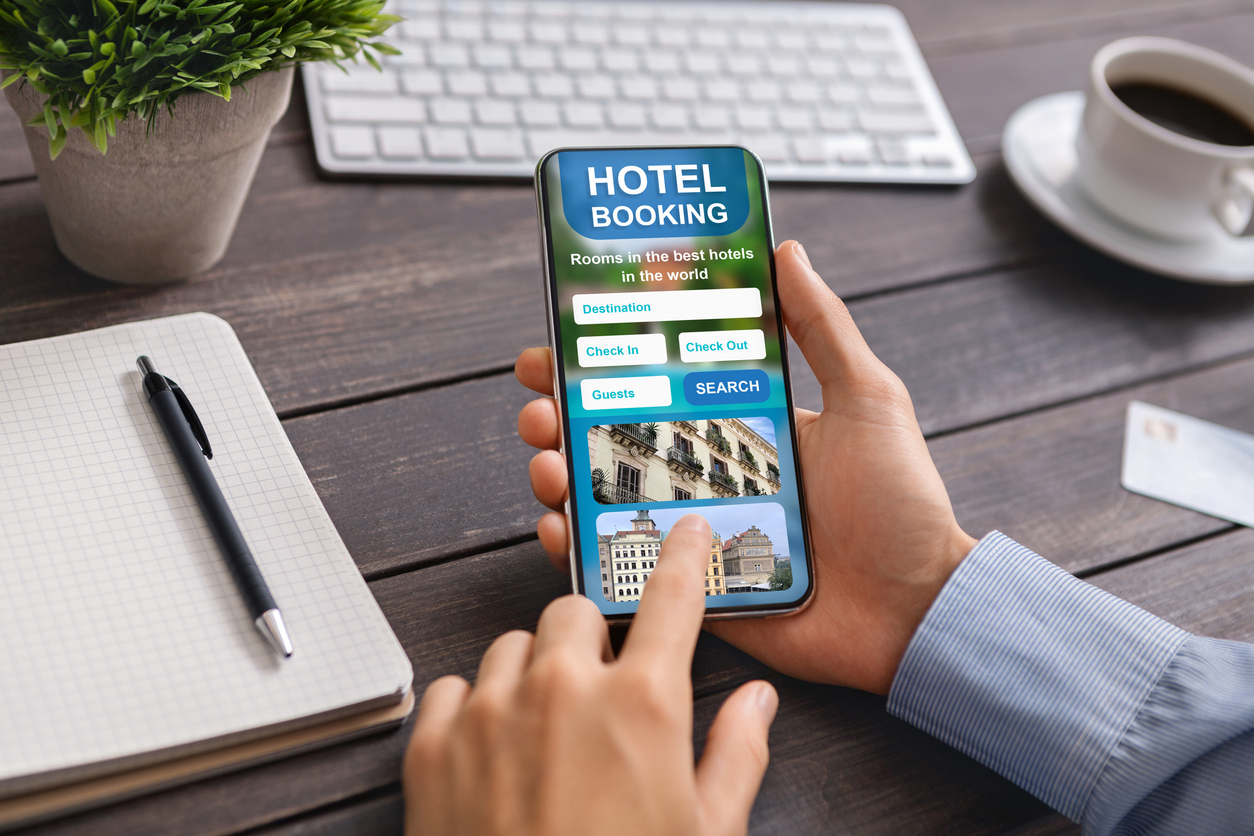 OTA commissions, often ranging between 15-30%, continue to be one of the highest controllable costs in hotel distribution. Automation offers a practical way to reduce that dependency over time, not by eliminating OTAs, but by making direct bookings more competitive and more attractive.
Key hospitality automation workflows include:
- Automated rate parity or strategic price advantages on direct channels
- Personalized booking engine experiences based on user behavior or segment
- Abandoned booking recovery emails triggered in real time
- Targeted offers for repeat guests or high-value segments
Each of these touches the guest journey at a different point, gently steering bookings toward direct channels. Over time, this compounds: every direct booking is not just revenue gained, but commission avoided.
When integrated into a unified system like Zucchetti North America’s platform, these workflows are connected to guest profiles, CRM data, and revenue strategy, making them far more effective than standalone tools.
4. Self-Service Check-In: Hotel Room Automation That Starts Before Arrival
Guest expectations have shifted significantly. Many travelers now expect to check in before arrival, choose their room, and receive a mobile key without waiting at a front desk.
Hotel room automation makes this possible through mobile check-in flows, kiosks, and digital key delivery systems. Guests can complete identity verification, payment authorization, and room selection before stepping into the property.
For hotels, the operational benefits are just as important as the guest experience improvements:
- Reduced front desk congestion during peak arrival times
- Faster check-in throughput without additional staffing
- More time for staff to focus on personalized guest interactions
This isn’t about replacing human service. It’s about removing repetitive administrative steps so staff can engage where it actually matters.
5. POS Automation in Food and Beverage: Faster Service, Fewer Errors
Food and beverage operations are often the most manually intensive part of a hotel outside of rooms. Orders taken on paper, delayed communication to kitchens, and manual posting to guest folios all introduce friction and errors.
An automated POS system streamlines this entire workflow. Orders entered via mobile devices or terminals are instantly routed to kitchen display systems, reducing miscommunication and improving preparation speed. At the same time, real-time inventory tracking helps prevent stockouts or overselling menu items.
When integrated with the property management system (PMS), charges are automatically posted to guest folios, eliminating manual reconciliation and reducing billing errors at checkout.
The result is:
- Faster table turnover
- Fewer order mistakes
- Cleaner, more accurate guest billing
In integrated environments like Zucchetti North America’s hospitality stack, this connection between POS and PMS becomes seamless rather than a patchwork of workarounds.
6. Luxury Hotel Automation: What High-Touch Service Looks Like With Technology Behind It
 A common concern in boutique and luxury hospitality is that automation risks removing the human element. In practice, the opposite is often true.
Luxury hotel automation is not about replacing service. It’s about enabling it. When staff are not tied up with manual rate updates, fragmented systems, or billing corrections, they can focus entirely on guest interaction and personalization.
Examples of automation supporting high-touch service include:
- Pre-arrival preference capture that informs room setup and amenities
- Intelligent upsell recommendations based on guest profile and booking behavior
- Seamless routing of F&B and ancillary charges without manual intervention
- Unified guest profiles that give staff instant context at every touchpoint
The key shift is visibility and time. Technology handles the operational complexity in the background, while the guest experiences a smoother, more attentive, and more personalized stay.
In this model, automation becomes invisible, but its impact is very visible in the quality of service delivered.
Frequently Asked Questions
What is hotel automation in simple terms?
Hotel automation refers to using connected systems and software to handle repetitive operational tasks that would otherwise be done manually. This includes pricing updates, channel management, check-in processes, and billing. The goal isn’t to replace staff, but to reduce manual workload so teams can focus more on guest experience and higher-value service tasks.
Do small or independent hotels really need automation systems?
Yes, in fact, independent hotels often benefit the most because they typically operate with smaller teams and tighter margins. Automation helps level the playing field by improving revenue management, reducing distribution errors, and increasing direct bookings without requiring large operational teams or enterprise-level budgets.
Will automation reduce the need for hotel staff?
No. Properly implemented hospitality automation is designed to support staff, not replace them. It removes repetitive administrative work such as updating rates or reconciling bookings, allowing employees to spend more time interacting with guests, solving problems, and delivering personalized service where it matters most.
What areas of a hotel benefit most from automation?
The biggest impact is usually seen in revenue management, channel distribution, guest check-in, and food & beverage operations. These areas involve high volumes of repetitive tasks and real-time decisions. Automating them improves speed, accuracy, and revenue performance while reducing operational strain on teams.
Is hotel automation expensive to implement?
Costs vary depending on the size of the property and the systems in place, but many modern hotel automation platforms are modular and scalable. This means hotels can start with high-impact areas like revenue management or distribution and expand over time, making it easier to align investment with operational priorities and ROI.
Conclusion: Where to Start
 No property automates everything overnight, and the most successful implementations don’t try to. Start by identifying your single most visible pain point (e.g., rate management, channel mismatches, check-in bottlenecks, or F&B billing errors) and solve that first. The efficiency gains build momentum, and as systems begin to connect, automation shifts from isolated fixes to a coordinated operational strategy.
The hotels best positioned for the next five years aren’t necessarily the largest. They’re the ones that started building smarter operational foundations early.
Contact us to explore what an integrated automation approach could look like for your property.





Related Articles

Generative AI in Hospitality: Practical Uses for Growth
The way travelers search for hotels has fundamentally changed. Not long ago, a guest might...

North America
Zucchetti North America offers hospitality solutions to hotels and other lodging providers, as well as on-site dining operations across North America.
Quick Links
Contact Us

34 West Oak St, Sturgeon Bay, WI 54235
7901 Kingspointe Pkwy Ste 9, Orlando, FL 32819
500 SW 116th Ave, Portland, OR 97225

+1.503.343.4263

sales@zucchettinorthamerica.com
©2026 Zucchetti. All rights reserved.